

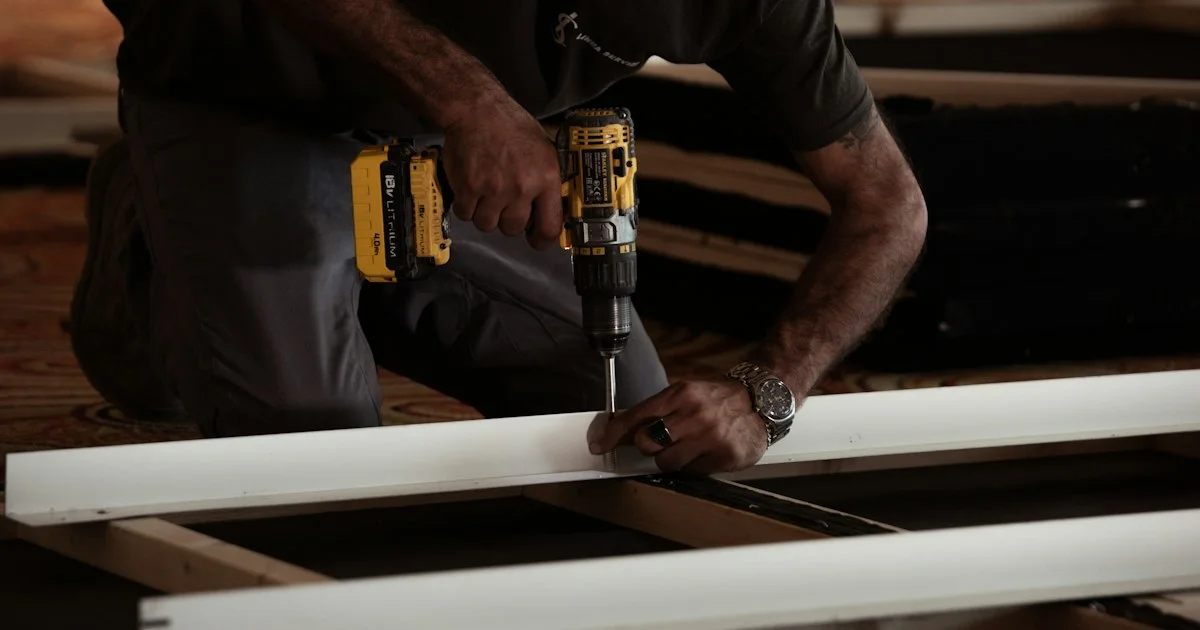
A cordless drill is the one power tool almost every household ends up owning, and it is also the one most people buy twice: once on price, and once properly. Answering which cordless power drill to buy 2026 shoppers can live with for a decade means settling four things before you look at a price tag at all — the battery platform, the motor, the chuck, and how much torque the work actually needs. None of those is the number printed largest on the box.
How to shortlist in five steps
Work through these in order. Each one cuts the shelf down, and the last step is the only place where the marketing numbers matter.
- Pick the battery platform before the drill. Batteries do not cross brands. The first cordless tool you buy quietly decides what your sander, your circular saw and your leaf blower will be for the next ten years, because the packs and chargers only fit their own family.
- Choose a size class: compact or full-size. This is the single biggest comfort decision, and it is easier to get right by picking up two drills than by reading a spec sheet.
- Choose the tool type. A drill/driver handles almost everything indoors. A hammer drill adds a percussion mode for masonry. An impact driver is a different tool entirely and is not a replacement for either.
- Check the chuck. Legacy Tool Supply puts a 1/2-inch metal-jaw keyless chuck as the full-size standard, which takes every common bit; compact 12-volt drills typically use a 3/8-inch chuck, which rules out the biggest hole-making bits.
- Match torque to the heaviest job you honestly do. Not the heaviest job you can imagine doing.
What a compact 12-volt drill gives you
A 12-volt drill is short from chuck to back, light in one hand, and it fits between studs and inside cabinets where a full-size tool simply will not go. The trade is straightforward and the specs say so plainly: a smaller chuck, less torque, and a ceiling on what it will drive without stalling. For a whole category of ordinary work, none of that is a real limit.
The clutch matters more here than the voltage does. That numbered collar behind the chuck caps how hard the tool twists before it slips, which is what stops a screw head from stripping or a cabinet hinge from sinking through the door. A low clutch number is the difference between assembling flat-pack furniture and destroying it.
Who a 12-volt drill suits
- Apartment dwellers whose heaviest job is a curtain rail, a shelf bracket or a flat-pack wardrobe
- Anyone who does a lot of overhead work, where a pound of weight is felt within a minute
- People working in tight cabinets, closets and stud bays
- Anyone storing a drill in a kitchen drawer rather than a garage

What an 18-volt or 20V MAX drill gives you
The two labels describe the same class of tool — one brand quotes nominal voltage, another quotes peak — so do not read a difference into the numbers. What you get is a bigger chuck, a stronger gearbox and enough torque to keep going through dense material instead of bogging down.
Legacy Tool Supply’s torque bands are a useful reality check: around 300 in-lbs covers picture hangers and small screws, 500 to 700 in-lbs covers deck screws, mounting a TV and drilling studs, and 1,000-plus in-lbs is for lag bolts and large hole saws. Most homeowners live permanently in the middle band and buy for the top one.
Two other figures are worth knowing. A two-speed gearbox gives you a low, high-torque range for driving and a high, low-torque range for drilling, and using the right one does more for results than another 200 in-lbs. On batteries, a 2.0Ah pack is the runtime baseline and a 5.0Ah pack roughly doubles it — at the cost of noticeable weight hanging off the handle.
Who a full-size drill suits
- Homeowners with a yard, a deck, a fence or a garage full of projects
- Anyone drilling into brick, block or concrete, where a hammer mode is not optional
- People who already own tools on an 18V or 20V MAX platform and should stay there
- Anyone building furniture from lumber rather than assembling it from a box
Brushless or brushed, and when the difference is real
A brushless motor swaps carbon contact brushes for electronic commutation. In practice it runs cooler, gets more work out of each charge, and lasts longer because there are no brushes wearing down inside it. That is a genuine improvement, not marketing.
It is also not always worth the premium. If the drill comes out four times a year for shelf brackets, a brushed motor will outlive your interest in the hobby. If it runs for an hour at a stretch, brushless pays for itself in heat, runtime and service life. How to buy the best cordless power drill for your situation usually means being honest about which of those two people you are.
Hammer drill or impact driver? They are not interchangeable
A hammer drill adds a forward-and-back percussion action to help a masonry bit chip through brick and concrete. It is still a drill, it still has a chuck and a clutch, and you switch the mode off for wood.
An impact driver is a separate tool that delivers rotational hammer blows to drive long fasteners. It takes 1/4-inch hex bits rather than round shanks, it usually has no clutch, and it is loud. It will sink a six-inch structural screw a drill would stall on, and it will happily snap a small brass screw in half. The top cordless power drill for USA households is a drill/driver first; an impact driver is a second purchase, not a substitute.
Buyer’s decision table
| If you want this | Buy this | What you give up |
|---|---|---|
| Something light you will actually reach for | 12V compact drill/driver, 3/8-inch chuck | Large hole saws and heavy lag work |
| One drill for the whole house and yard | 18V or 20V MAX drill/driver, 1/2-inch chuck | Weight, and a drawer will not hold it |
| To drill brick, block or concrete | Full-size hammer drill | More noise, more bulk, more money |
| To drive long structural screws fast | Impact driver alongside a drill | Clutch control and quiet operation |
| Maximum runtime on a long job | 5.0Ah packs on a brushless tool | Handle weight and battery cost |
| The lowest sensible price | Brushed 18V kit with two 2.0Ah packs | Runtime per charge and long-term life |
Frequently Asked Questions
Four questions come up more than any others once the shortlist is down to two tools.
Is a higher voltage drill always more powerful?
No. Voltage describes the battery, not the gearbox, and a well-built 12-volt tool can out-drive a cheap 18-volt one. Torque in inch-pounds and the quality of the two-speed gearbox tell you far more about what the drill will actually do.
Do I need a hammer drill for a brick wall?
For more than one or two holes, yes. A standard drill/driver with a masonry bit will get through soft brick slowly and will struggle badly in concrete or block. Hammer mode is what makes that job take a minute instead of twenty.
How many batteries should a kit include?
Two, so one is charging while the other works. A kit with a single pack is usually a false economy, because buying a second battery separately often costs more than the gap between the one-pack and two-pack kits.
Is a brand-name drill worth it over a store brand?
Often, but for an unglamorous reason: batteries and service parts stay available for years on the major platforms and vanish quickly on the others. The best cordless power drill for USA buyers is frequently the one whose replacement pack will still be on a shelf in 2031.
Conclusion
Choose the battery platform first, pick the size class you will actually pick up, and match torque to the work you really do rather than the work you picture doing. Get those three right and the drill itself is close to a formality.


