

Most people buy an electric kettle twice: once on price, and once properly, after the first one leaves a plastic taste in their tea. The best electric kettle 2026 shoppers can buy comes down to three things — what the water touches, whether you can set a temperature, and how the spout pours.
How to buy the best electric kettle in five steps
Working out how to buy the best electric kettle is mostly a process of elimination. Run these five checks in order and the shortlist shrinks fast.
- Check the interior material, not the outside. A stainless steel body with a plastic lid and plastic water gauge is still a plastic kettle where it counts.
- Decide if you need set temperatures. If you drink only black tea or instant coffee, a plain boil is fine. If you drink green tea or brew pour-over, temperature control is the whole purchase.
- Pick a spout shape. A wide jug spout fills mugs fast. A gooseneck pours slowly and precisely, which matters for coffee and nothing else.
- Match the capacity to your household. Bigger kettles take longer to heat and hold more standing water, which is the main cause of stale-tasting reboils.
- Look at the lid and the base. A lid you can get your hand inside is a kettle you can actually descale.
What a standard jug kettle gives you
The jug kettle is the everyday workhorse: a wide body, a broad spout, and usually 1.5 to 1.7 liters of capacity. It boils a lot of water quickly and fills a teapot or a French press without fuss.
Materials are where jug kettles separate. Food-grade 304 stainless steel — sometimes labeled 18/8 — is taste-neutral, so water boiled in it tastes like water. Borosilicate glass, the same material used in lab glassware, does not leach anything either, but it is heavier and it shatters if you drop it. Plastic interiors are the single most common source of off-taste complaints in the category; the flavor usually fades after 10 to 20 boil cycles, and “BPA-free” does not prevent it, because the issue is hot water against plastic rather than one specific compound.
Who a jug kettle suits
- Households that boil for several people at once
- Black tea, herbal tea, and instant coffee drinkers, who want a full boil anyway
- Anyone filling a French press, a teapot, or a pot on the stove
- Small kitchens, since jug kettles take up less counter depth than a kettle on a wide control base

What a gooseneck kettle gives you
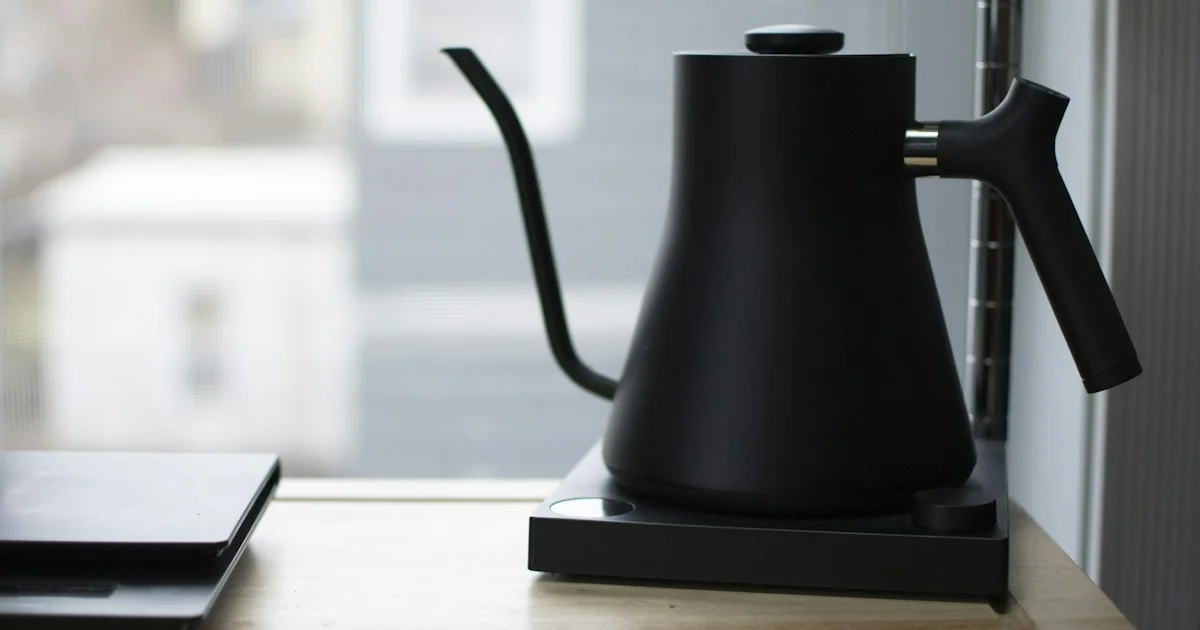
A gooseneck kettle trades speed for control. The narrow curved spout releases a thin, steady stream you can aim, which is the difference between soaking a coffee bed evenly and blasting a channel through it. Nearly all of them sit on a base with a temperature readout and a set of presets.
They are smaller — typically 0.8 to 1 liter — and they take longer to fill a large teapot. If you are not making pour-over coffee or gong-fu tea, the gooseneck buys you very little, and the same money spent on a temperature-controlled jug kettle buys more usable water.
Who a gooseneck kettle suits
- Pour-over and AeroPress drinkers who want to control the pour rate
- Loose-leaf tea drinkers brewing small volumes at specific temperatures
- Anyone who already owns a scale and wants repeatable results
- One- or two-person households where 1 liter is plenty
Temperature is what separates the top electric kettle for USA kitchens
The top electric kettle for USA kitchens is usually a variable-temperature model, because American households drink coffee and tea that want very different water. The Specialty Coffee Association range for brewing coffee is 195°F to 205°F. Go below it and the cup comes out sour, thin, and hollow; go above it and you get harsh, dry, bitter results, with a full 212°F boil scorching the grounds outright.
Tea is even less forgiving. Green and white teas want 175–180°F, oolong around 195°F, and black, herbal, and pu-erh teas a full 212°F. Boiling water poured on green tea is the most common reason people think they dislike it.
Two practical notes. Water in an open kettle drops roughly 2°F every 10 seconds at room temperature, so without a temperature setting you are waiting and guessing. And water boils about 2°F lower for every 1,000 feet of elevation, which is worth knowing if you live in Denver rather than Miami.
Which electric kettle should I buy?
If you are still asking which electric kettle should I buy, match the left column to the right. These are categories rather than model numbers, so the advice holds as products change.
| If you want this | Choose this |
|---|---|
| Fast boils for a whole household | 1.7-liter stainless jug, single boil setting |
| Green or white tea that does not taste bitter | Variable-temperature jug kettle |
| Pour-over coffee you can repeat | Gooseneck with a temperature readout |
| No plastic touching the water at all | Full 304 stainless or borosilicate glass interior |
| Easy descaling in hard-water areas | Wide-opening lid, stainless interior |
| The lowest running cost and least clutter | Plain stainless jug, no control base |
Frequently Asked Questions
A few things come up repeatedly once the shortlist is down to two or three kettles.
Does a plastic kettle actually affect the taste?
Often, yes, and most noticeably when the kettle is new. The off-taste usually settles after 10 to 20 boil cycles. If it bothers you, the fix is a kettle with a 304 stainless or borosilicate glass interior rather than a different plastic.
Is a gooseneck kettle worth it for tea?
Only for small, careful brews. For a mug of black tea or a teapot, a jug kettle is faster and holds more. The gooseneck earns its place when you are pouring slowly over coffee grounds or brewing loose leaf in small vessels.
How often should I descale an electric kettle?
It depends entirely on your water. In hard-water areas you may see chalky scale within a month; in soft-water areas it can take a year. Descale when you can see a white film on the element or the inside wall, and choose a kettle with an opening wide enough to get a cloth inside.
Do higher-wattage kettles boil faster?
Generally yes, but the difference is smaller than the number suggests, because a standard US outlet limits how much power any countertop kettle can draw. Capacity and starting water temperature affect boil time more than the wattage on the box.
Conclusion
Buy for the interior material first, temperature control second, and spout shape last. A 304 stainless jug with variable temperature covers almost every household, and the gooseneck is worth the trade only if pour-over coffee is part of your morning.


