

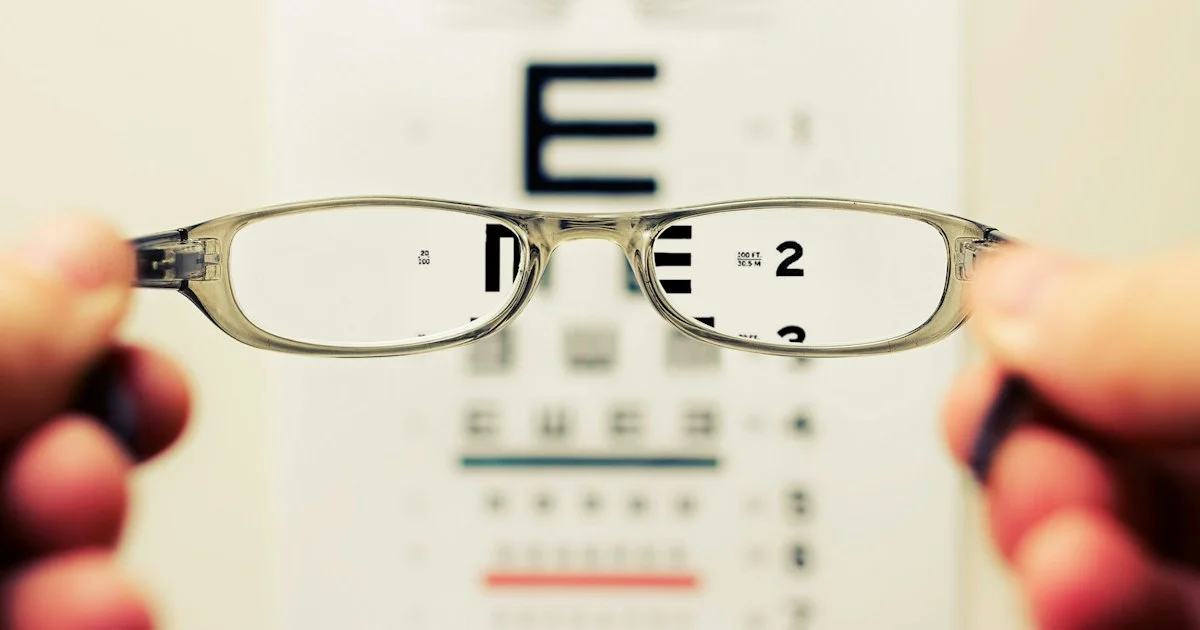
The shop sells you the frame. Someone else has already written down the part that has to be right, and federal law says you are entitled to walk out with a copy of it. Any honest guide to the best eyeglasses online 2026 therefore starts with a piece of paper rather than with a shortlist of stores.
This article draws on the Federal Trade Commission’s Eyeglass Rule (16 CFR Part 456) and the Food and Drug Administration’s impact-resistant lens requirement (21 CFR 801.410). It is general information about buying eyewear, not medical advice, and it is not a substitute for an eye examination. Any change in your vision is a reason to see an eye doctor rather than to reorder glasses.
The rule that comes before the shortlist
The FTC’s Eyeglass Rule exists for exactly the situation you are in. In the Commission’s own words, the rule “has promoted competition by ensuring that consumers can shop around for lower prices.” It does that by taking your prescription out of the examining room and putting it in your hands.
Under section 456.2(a)(1), a prescriber must give you one copy of your prescription “immediately after the refractive eye examination is completed and before offering to sell ophthalmic goods.” Not on request. Not after you decline the frames on the wall. Before the selling starts.
Three companion provisions matter just as much:
- A practitioner may not “condition the availability of a refractive eye examination on a requirement that the patient agree to purchase ophthalmic goods” (section 456.2(b)).
- A practitioner may not “charge any fee in addition to the examination fee as a condition to releasing the prescription” (section 456.2(c)).
- A prescriber may not put disclaimers on the prescription or ask you to sign anything “waiving or disclaiming the liability or responsibility of the ophthalmologist or optometrist” (section 456.2(d)).
Since the updated rule took effect on September 24, 2024, prescribers also have to confirm the handoff. Section 456.4(a) requires them either to ask you to sign a statement confirming you received a paper copy, or, for a digital copy sent by portal, email or text, to “retain evidence that such prescription was sent, received, or made accessible, downloadable, and printable.” Those records are kept for not less than three years. In practice this means a copy of your prescription almost certainly exists somewhere you can reach it, even if you never thought to ask for one.
One scope point is worth getting right, because it is the single most common cause of a failed online order. The rule defines a prescription as “the written specifications for lenses for eyeglasses which are derived from a refractive eye examination, including all of the information specified by State law, if any, necessary to obtain lenses for eyeglasses.” Pupillary distance is not named in that federal definition. Whether your prescription carries it depends on your state, which is why so many online orders stall at the measurement step rather than at checkout.
How to shortlist in five steps
- Get the prescription in writing first. Request the copy you are owed, or the record of the digital copy, before you compare a single store. If a practice charges you or stalls, the Eyeglass Rule is the reason it should not.
- Read what is actually on it. Sphere, cylinder, axis and add power will be there. Pupillary distance may not be. Find out before you order, not after.
- Check the expiration. Prescription validity is set by state law and varies, so confirm yours is still current rather than assuming a standard term.
- Match the seller to the prescription, not to the price. Strong corrections, high cylinder values, progressives and prism are where cheap orders fail. A seller that quietly declines to fill an unusual prescription has told you something useful.
- Read the remake and return terms before you pay. The first pair is a measurement experiment. Treat a one-time free remake as a feature you are buying, not a bonus.
What the best eyeglasses online 2026 sellers give you
Selection is the honest advantage, and it is a large one. A physical optical shop stocks what fits on its walls. An online catalog is limited only by what a lab can cut, which is why the same correction can be ordered in a titanium rimless, an acetate round and a wrap frame without anyone driving anywhere.
The second advantage is unbundling. At a counter, the frame, the lens, the coatings and the fitting arrive as one number. Online, each line is priced separately, so it is obvious what an anti-reflective coating or a high-index lens is actually costing you, and equally obvious when a coating is being sold as a package you cannot decline.
The third is that a second pair stops being a luxury. When the frame is the cheap part of the order, a backup pair for the car or the workshop becomes a rounding error rather than a decision.
Who ordering online suits
Buying online works best for a single-vision prescription in a moderate range, for a repeat order of a frame shape you already know fits, and for anyone whose prescription has been stable for a while. It also suits people who want a specific frame style their local shops do not carry, and people buying a spare rather than their only pair.

What an optical counter still gives you
An optician measures your face on your face. Pupillary distance, segment height for progressives, pantoscopic tilt, vertex distance and how a frame actually sits on your nose and ears are all judged in person, and they are judged again when you collect the glasses. If something is wrong, the adjustment happens in front of you with a heat gun and a pair of pliers rather than through a returns portal.
The counter also carries the awkward cases well. Progressive lenses in particular are unforgiving: a segment height that is a few millimeters out, roughly an eighth of an inch, moves the reading zone to somewhere your eyes do not naturally go. That is a fitting problem, not a manufacturing one, and it does not show up until you try to read with them.
Who the counter suits
Go in person for a first pair of progressives, for a high or unusual prescription, for prism, for children, and for anyone who has had a run of glasses that never felt right. Go in person as well if you simply do not want to manage the measurement step yourself, which is a perfectly reasonable thing to pay for.
What the top eyeglasses online for USA shoppers still cannot do
The top eyeglasses online for USA buyers cannot measure your face through a screen, and that is the whole of the difficulty. Three numbers have to come from somewhere other than the seller’s catalog:
- Pupillary distance. The distance between the centers of your pupils. It may or may not be on your prescription.
- Frame dimensions. Lens width, bridge and temple length are usually printed on the inside of a pair you already own, which makes an old frame the best measuring tool you have.
- Segment height. Only relevant for progressives and bifocals, and the reason many sellers decline those orders or route them to a partner store.
App-based measurement tools have improved, but they are estimating from a photograph. For a single-vision order in a moderate range that estimate is usually good enough. For a progressive it often is not.
Where the best eyeglasses online for USA orders go wrong
An order for the best eyeglasses online for USA customers is still a mail-order product, and the failure modes repeat. Lenses arrive correct but the frame sits too low. Coatings are bundled invisibly into a price that looked like a bargain. A progressive arrives technically accurate and unusable. Turnaround stretches when a lab has to surface an unusual prescription.
There is also a safety requirement worth knowing about, because it is one of the few things federal law says about the lens itself rather than the paperwork. Under 21 CFR 801.410, “eyeglasses and sunglasses must be fitted with impact-resistant lenses, except in those cases where the physician or optometrist finds that such lenses will not fulfill the visual requirements” of a particular patient, in which case the patient gets written notification. The test the FDA describes is blunt: a five-eighths-inch steel ball weighing about 0.56 ounce is dropped onto the lens from a height of 50 inches, and the lens must not fracture through its full thickness. Manufacturers keep the invoices, shipping documents and test records for three years.
That requirement applies to the lens, not to the channel you bought it through. It is a reason to ask a seller what its lenses are made of rather than a reason to avoid ordering online.
How to buy the best eyeglasses online without a second order
Knowing how to buy the best eyeglasses online mostly means front-loading the boring parts. Have the prescription in hand and read it. Get your pupillary distance from the prescriber or from a pair that already fits. Copy the three numbers printed inside your current frame. Choose a lens material that suits the correction rather than the price, and decline coatings you cannot explain.
Then read the remake policy one more time before you click. The gap between a store that remakes a first pair once at no charge and a store that treats every order as final is the difference between an experiment and a gamble.
Match the route to the prescription
| If this describes you | Buy here | Because |
|---|---|---|
| Single vision, stable prescription, want a spare | Online | Selection and unbundled pricing work entirely in your favor |
| First pair of progressives | In person | Segment height is measured on your face and checked at collection |
| Reordering a frame you already own | Online | The fit is already proven and the numbers are printed inside the temple |
| High correction, prism, or an unusual axis | In person, or an online seller that accepts it openly | Lab capability varies and a quiet decline is a warning |
| Children’s glasses | In person | Fit changes fast and adjustments are constant |
| Prescription sunglasses as a second pair | Online | Lower stakes, and tint and coating choices are broader |
Frequently Asked Questions
The questions below come up more than any others once the prescription is in hand.
Does my eye doctor have to give me my prescription?
Yes. The FTC’s Eyeglass Rule requires a prescriber to provide one copy “immediately after the refractive eye examination is completed and before offering to sell ophthalmic goods.” They cannot charge a separate fee to release it, and they cannot make the exam conditional on your agreeing to buy glasses.
Why is my pupillary distance missing from my prescription?
Because the federal definition of a prescription does not name it. The rule covers the lens specifications plus whatever state law requires, so pupillary distance appears on some prescriptions and not others. Ask for it, or measure it from a frame that already fits you.
Are online lenses less safe than lenses from a shop?
The impact-resistance requirement in 21 CFR 801.410 applies to the lenses themselves regardless of where they are sold. What varies is the lab, the material and the coatings, which is why asking a seller what it actually puts in the frame is a better question than asking whether online is safe.
Can I order progressives online at all?
You can, and some people are happy with the result. The risk is concentrated in segment height, which is a measurement of where your eyes sit in that specific frame. If this is your first pair of progressives, the counter is the lower-risk route.
Conclusion
Buying eyewear online is a paperwork problem dressed up as a shopping problem. Get the prescription you are legally entitled to, find out whether it carries your pupillary distance, and the rest of the decision is about selection, price and how forgiving the remake policy is. Order the straightforward pairs online, and take the awkward prescriptions to someone who can measure them on your face.


