

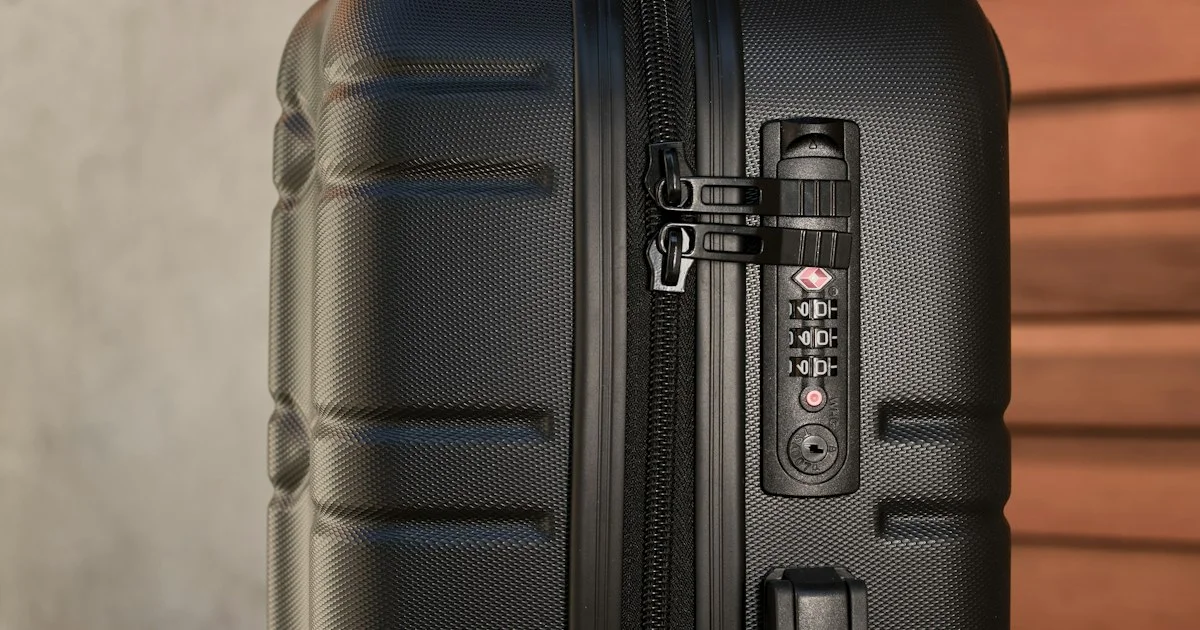
No company selling a luggage padlock in the United States is allowed to tell you a federal agency approved it, because no federal agency approves luggage locks at all. That single gap explains most of the confusion around how to choose a bluetooth luggage lock, and it is the reason two very different rulebooks decide what your lock is actually worth on a bad travel day.
This guide names no lock maker. It is built on published federal rules and on the public pages of the organization that licenses the best known luggage-lock mark, and it describes United States domestic air travel. Your own airline contract of carriage sets terms this guide cannot see, so read it before you rely on any figure here. Locks that run on a small coin or button cell also fall under child-safety packaging and warning requirements, so keep spare cells away from young children.
Two rulebooks decide what your lock is worth
A lock on a checked bag can fail in two different ways, and each one sends you to a different counterparty with a different deadline.
The first is the airline. Under 14 CFR 254.4, a carrier “shall not limit its liability for provable direct or consequential damages resulting from the disappearance of, damage to, or delay in delivery of a passenger’s personal property, including baggage, in its custody to an amount less than” the federal floor. The Department of Transportation raised that floor to $4,700 per passenger effective January 22, 2025, under a rule that notes “Section 254.6 requires rounding the adjustment to the nearest $100, which is $4,700.”
What the airline may carve out of that floor matters more. DOT states plainly that “airlines often exclude liability for certain categories of items (for example: fragile items, electronics, cash, perishable items, other valuables, etc.).” An electronic lock is, on its face, an electronic item. DOT is equally plain in the other direction: “airlines cannot exclude liability for damage to wheels, handles, straps, and other components of checked baggage.” A lock bolted into the shell of a suitcase is a component of that bag. A battery-powered gadget clipped to the outside is easier to argue about.
The second route has nothing to do with the airline. If a lock is cut during security screening, the counterparty is the United States government, and the instrument is a tort claim. Under 28 CFR 14.2(a), a claim is presented only when an agency receives “an executed Standard Form 95 or other written notification of an incident, accompanied by a claim for money damages in a sum certain.” The clock is unforgiving: 28 U.S.C. 2401(b) says a tort claim against the United States “shall be forever barred unless it is presented in writing to the appropriate Federal agency within two years after such claim accrues.”
So the buying question is not which lock is strongest, but which lock keeps you inside the rulebook that actually pays.
You can check current options here:
Check on Amazon See on Walmart
Exactly how to choose a bluetooth luggage lock in five steps
Work through these in order. Each one can end the decision on its own.
- Decide whether the bag will be checked or carried on. A carry-on bag is never opened out of your sight, so a lock on it is a theft deterrent in a hotel or hostel, not a screening problem. Almost every hard question below applies only to checked bags.
- Find out whether the lock carries a licensed screening mark. The red diamond and the torch are private certification marks, licensed to lock makers by two separate organizations. A lock without one is a lock a screener cannot open any other way.
- Check what the lock does when the battery dies. This is the question most listings answer badly. A lock with a mechanical dial or a keyed override still opens on a dead cell. A lock with only a radio and an app does not.
- Read the radio warning the law already requires. Every unlicensed radio device sold in the United States must carry the statement in 47 CFR 15.19(a)(3), and it tells you more than the marketing does.
- Decide who else needs to open the bag. A shared family suitcase with one phone-bound lock is a daily argument. A dial code can be told to someone over a phone call; an app pairing usually cannot.
What a bluetooth lock gives you
The advantages are real but narrow. You stop memorizing a code, and you can usually see a log of when the shackle was opened. Some models hand temporary access to a travel companion without revealing a permanent number. For a bag several people borrow across a year, that audit trail is the one thing a dial lock cannot imitate.
The cost is a dependency chain that a dial lock does not have: a charged phone, a working app, a paired account, and a live cell inside the lock. Each link is a place the lock can refuse you at an airport counter.
Step four of the shortlist exists because the law already warns you about one of those links. The statement required by 47 CFR 15.19(a)(3) reads: “This device complies with part 15 of the FCC Rules. Operation is subject to the following two conditions: (1) This device may not cause harmful interference, and (2) this device must accept any interference received, including interference that may cause undesired operation.” Read that second condition again. A legally compliant unlicensed device is one that is required to tolerate being disrupted. An airport is a dense radio environment. That is not a defect in any particular lock; it is the deal every Part 15 device makes.
Who a bluetooth lock suits
- Travelers who lock a bag mostly in hotel rooms, hostels and rentals rather than in the hold.
- Households that share one suitcase and want to know who opened it and when.
- People who already carry a power bank and treat a dead phone as a solved problem.

What a plain combination lock gives you
A three-dial or four-dial lock has no battery, no pairing and no account. It opens in the dark, in a dead zone, with a flat phone, and it keeps opening a decade later. Where it is integrated into the suitcase shell rather than clipped to the zipper pulls, it also sits more comfortably inside the DOT language about components of checked baggage.
Its weakness is the familiar one. You have to remember the number, a shared bag means a shared number nobody can revoke, and there is no log to tell you the bag was opened.
Who a plain combination lock suits
It suits the traveler whose bag spends most of its locked hours in an aircraft hold, anyone who flies rarely enough that a dead battery would surface at the worst moment, and anyone buying for a parent or child who should not need an app to open their own suitcase. It is also right for a bag that gets lent out, since a code changes in ten seconds without anyone downloading anything.
What a top bluetooth luggage lock for USA buyers has to prove
A top bluetooth luggage lock for USA buyers has to clear a bar that has nothing to do with build quality: it has to be openable by a screener without being destroyed. That capability comes from a licensed mark, and it is worth being precise about what the mark is.
Travel Sentry, which licenses the red diamond, describes itself on its own site this way: “At Travel Sentry, we set the global standard for travel security. Our Travel Sentry locks and identification systems are trusted by airports, security agencies and luggage brands.” It calls the Red Diamond “a worldwide symbol of trust and quality” and says the system reaches “80 Countries” and “800 Airports” and “over 2 billion passengers every year.”
Notice what those sentences do not say. None of them says a government agency tested the lock, certified it, approved it, or inspected the factory that made it. “Trusted by” is a commercial claim about adoption, not a regulatory one about review. The mark tells you a screener probably has a way in, and nothing about how hard the lock is to defeat.
Where a best bluetooth luggage lock 2026 roundup goes wrong
Most lists chasing the best bluetooth luggage lock 2026 title rank on shackle thickness, app polish and battery life. Those three matter least, because a checked-bag lock is not a security device in any serious sense. The fabric panel beside it opens with a pen, and the zipper re-closes afterwards. A luggage lock is a tamper indicator and a casual deterrent.
Judged as a tamper indicator, the ranking changes completely. The useful questions become whether the lock survives a baggage belt, whether it fails open or fails shut when the cell dies, whether it is attached to the bag in a way that makes it a component rather than an accessory, and whether it will still open on the return leg. Battery life only matters in that it sets how often you have to think about any of this.
Deciding which bluetooth luggage lock should I buy
If you are still stuck on which bluetooth luggage lock should I buy, stop comparing models and match your actual travel pattern to the row below.
| If this is you | Pick this | Because |
|---|---|---|
| You check a bag on most trips | An integrated lock built into the shell, carrying a licensed mark | It is a component of the bag, and a screener has a non-destructive way in |
| You mostly lock a bag in hotels and rentals | A bluetooth lock, mark optional | The bag is never out of your custody, so screening never meets the lock |
| Several people share the suitcase | A bluetooth lock with revocable access | Access can be withdrawn without changing anything the others memorized |
| You fly a few times a year | A plain dial lock | Nothing to charge, nothing to pair, nothing to discover at the counter |
| You are buying for a child or an older parent | A plain dial lock | No phone, no account and no app update stands between them and their own bag |
| You carry high-value items in the hold | Neither, and move the items | Airlines may exclude liability for electronics and valuables entirely |
Frequently Asked Questions
Four questions come up more than any others, and the answers are shorter than the marketing suggests.
Will security cut a bluetooth lock off my bag?
A lock carrying a licensed screening mark is designed so that it does not have to be cut. A lock without one leaves a screener no other option if the bag has to be opened. That is the biggest practical difference between the two kinds of lock, and it has nothing to do with price.
Does a lock make my checked bag safer from theft?
Only marginally. Soft-sided bags open without touching the lock, and a zipper re-closes afterwards. Treat a luggage lock as a sign the bag was disturbed, not as a barrier. If an item would hurt to lose, it belongs in your carry-on.
What happens if the battery dies mid-trip?
It depends on the model, which is why it is step three. Some locks keep a mechanical dial or keyed override for exactly this case. Others do not, and recovering access means contacting the maker or destroying the lock. Find the answer before you buy, not at the carousel.
Who pays if my lock is damaged?
It depends on who damaged it. If the damage happened to the airline, DOT says carriers “cannot exclude liability for damage to wheels, handles, straps, and other components of checked baggage,” and the domestic liability floor is $4,700 per passenger. If the damage happened during federal screening, the route is a tort claim on Standard Form 95 with a sum certain, and 28 U.S.C. 2401(b) gives you two years from when the claim accrues.
Conclusion
The honest summary is that a luggage lock is a small purchase governed by two large rulebooks, and the lock you want is the one that keeps the cheaper rulebook available to you. Check how often a bag of yours really goes in the hold, check what happens when the cell dies, and check whether the lock is part of the suitcase or hanging off it. The rest of the box is detail.


