

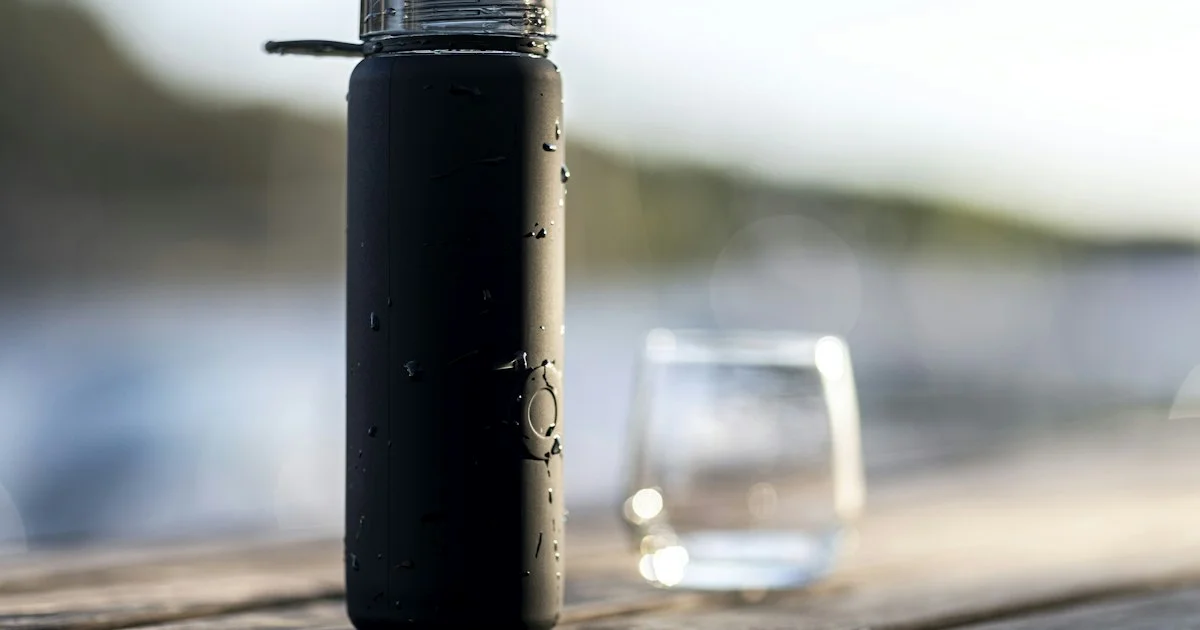
A smart water bottle is really two products that happen to share a lid. One counts what you drink and nudges you when you have not; the other claims to clean what is sitting inside. They are sold as a single object and they should be judged as two, so working out how to choose a smart water bottle starts with deciding which of the two you are actually paying for.
This guide covers how these products are regulated and what their labels mean. It is not medical advice, and the federal material below is general information. A bottle is also not a water treatment system: if the water going into it is not safe to drink, that is a question for your water utility and your doctor rather than for a cap with a lamp in it.
The sanitizing claim nobody reviewed
Before any feature list, the most useful fact about a self-cleaning bottle is where it sits in federal law. Under the Federal Insecticide, Fungicide, and Rodenticide Act, a device is “any instrument or contrivance (other than a firearm) [that] is intended for trapping, destroying, repelling, or mitigating any pest.” The EPA’s consumer guide to pesticide devices lists ultraviolet light units and water treatment units among its examples. A bottle with a UV-C lamp in the cap is one of them.
What follows is the part worth knowing before you pay. “FIFRA does not require registration of devices,” and in the agency’s own words, “device manufacturers, sellers, and distributors do not submit their claims or efficacy and safety data to EPA (for approval or otherwise) before selling or distributing a device.” If a box carries an EPA establishment number, that number “does NOT indicate that the product has been reviewed for safety or efficacy by EPA, nor does it imply EPA product approval, registration, certification, or endorsement.”
A kill-rate percentage printed on a bottle is therefore a manufacturer’s claim that no agency checked. That does not make it false. It makes it something to ask about rather than something to read and believe, and it moves the whole question of self-cleaning from the top of the shortlist to somewhere near the bottom.
How to choose a smart water bottle in five steps
- Treat the sanitizing claim as unverified. Ask the maker what the lamp was tested against, by whom, and for how long. If the answer is a percentage with no test behind it, price the bottle as though the lamp were not there.
- Work out if you need tracking at all. A bottle that logs sips solves a memory problem. If you already finish what you carry, you are buying a battery you do not need.
- Check how it washes. Electronics and dishwashers get along badly. Find out which parts come apart, which go in the machine, and whether the lid can be scrubbed by hand without drowning a circuit board.
- Check how it charges. A bottle that needs a proprietary charging puck is a bottle you cannot top up in a hotel room with the cable already in your bag.
- Read the material line, not the badge. “BPA-free” tells you less than most shoppers assume, for reasons covered further down.
What a tracking bottle gives you
The best smart water bottle 2026 shoppers are being offered in the tracking category does one honest thing well: it turns a vague intention into a visible number. A sensor in the base or the cap estimates how much has left the bottle, an app keeps a running total for the day, and a light or a buzz reminds you when the total has not moved in a while.
That is a genuinely useful behavior tool for some people and pure friction for others. The sensor is measuring the bottle, not you, so it cannot see the coffee, the soup or the tap water you drank from a glass at a friend’s house. The number it shows is a partial record that looks complete, which is worth remembering before you start treating it as a score.
Who a tracking bottle suits
- People who forget to drink during long stretches of focused work
- Anyone whose doctor has asked them to keep an eye on daily fluid intake and who wants a rough log rather than a guess
- Gadget-minded users who already live inside a health app and want one more stream feeding it
- Parents keeping half an eye on whether a teenager’s bottle is coming home full
It suits almost nobody who already drinks enough without prompting, and it is a poor fit for anyone who resents charging one more object.

What a self-cleaning bottle gives you
The top smart water bottle for USA buyers who want the self-cleaning version is offering convenience rather than safety. A small ultraviolet lamp in the cap runs on a timer or on demand, and the pitch is that you can go longer between proper washes without the bottle developing a smell.
Judged as convenience, that is a reasonable thing to buy. Judged as protection, it runs straight into the regulatory point above: nobody at a federal agency examined the claim before the product went on sale. Light also only acts on what it reaches, so a lamp pointed down the neck of a bottle is not doing anything about a gasket, a straw or a threaded lid seam. Those are exactly the places a bottle actually goes bad.
Who a self-cleaning bottle suits
It suits people who refill from known-good water all day and want the bottle to stay pleasant between washes — commuters, desk workers, anyone whose bottle lives in a bag. It does not suit backcountry use, travel to places where the tap water is a question, or anybody hoping to skip washing entirely. A UV cap is a deodorizer with ambitions, not a filter and not a purifier.
What “BPA-free” actually tells you
Deciding which smart water bottle should I buy often comes down to a badge on the side of the box, and this one deserves a closer look. The FDA’s current position, stated plainly on its own consumer page, is that “BPA is safe at the current levels occurring in foods,” and that “the available information continues to support the safety of BPA for the currently approved uses in food containers and packaging.”
The agency did remove BPA from its authorizations for baby bottles, sippy cups and infant formula packaging, and the reason is the interesting part. In the FDA’s words, “An amendment of the food additive regulations based on abandonment is not based on safety, but is based on the fact that the regulatory authorization is no longer necessary for the specific use of the food additive because that use has been permanently and completely abandoned.” The industry had already stopped; the rulebook caught up.
So “BPA-free” tells you which chemical is absent. It does not tell you that a regulator found a problem, and it says nothing about what was used instead. Stainless steel sidesteps the argument entirely and is the simpler answer for anyone who does not want to think about it again.
A buyer’s decision table
| If you want | Pick | Because |
|---|---|---|
| A nudge to drink more at a desk | A tracking bottle with a simple light | The reminder is the whole product; the app is optional |
| A log you can show a clinician | A tracking bottle with app export | A number you cannot get out of the app is a number you cannot use |
| A bottle that stays fresh in a gym bag | A UV cap, bought as convenience | Useful between washes, unreviewed as protection |
| Nothing to charge, ever | A plain insulated steel bottle | No battery, no app, no firmware to be discontinued |
| Hot drinks as well as cold | Double-walled steel, no electronics in the body | Heat and sensors are an unhappy combination |
| Something a child will not destroy | A plain bottle with a replaceable lid | Lids fail first, and a smart lid cannot be replaced for a few dollars |
Frequently Asked Questions
Three questions come up more than any others once the shortlist is down to two or three bottles.
Does a UV cap mean I can stop washing the bottle?
No. Ultraviolet light acts on the surfaces it reaches, and the parts of a bottle that turn unpleasant — the gasket groove, the straw, the threads under the lid — are the parts the lamp is pointing away from. Treat the cap as something that buys you time between washes, not something that replaces them.
Can a smart bottle make questionable water safe to drink?
Do not buy one on that basis. These products are sold as convenience items, the sanitizing claims are not reviewed by the EPA before sale, and a cap lamp is not a filter. If you are worried about what is coming out of a tap, that is a matter for your water utility’s annual quality report or a properly certified treatment product.
How long does the battery actually last?
It varies too much by design to give a single figure, and the claim on the box is measured under conditions the maker chose. The more useful question is what the bottle does when the battery dies: a good one is still a bottle, and a badly designed one will not open, seal or pour until it is charged. Ask that before you ask about runtime.
Conclusion
Buy the tracking if you want the habit and the plain bottle if you do not, and treat the self-cleaning lamp as a pleasant extra rather than a reason to pay more. The regulatory picture is the shortcut here: the feature with the boldest promise is the one nobody checked, and the badge everybody looks for means less than the shelf implies.


