

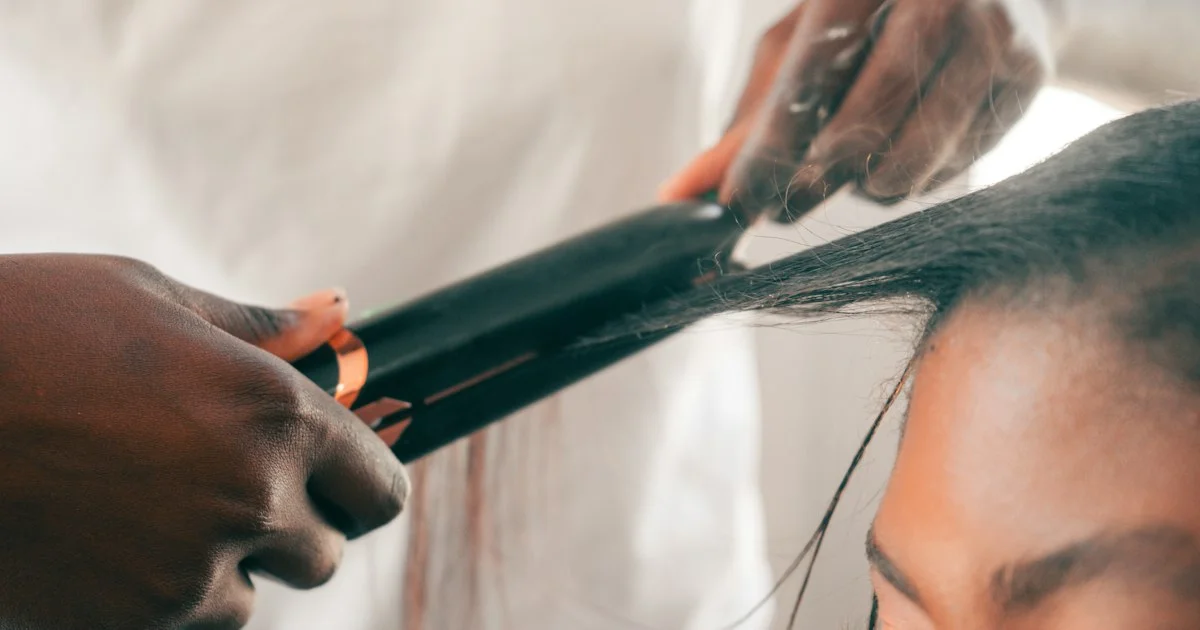
Straighteners all look the same on the shelf: two plates, a dial, a cord. The reason one leaves hair glossy and another leaves it dull is rarely the price. If you are asking which hair straightener should I buy, the useful answer starts with your hair rather than the tool, because plate size and temperature range only mean anything once you know what they have to get through.
How to shortlist in five steps
Run through these before you compare two models. Most of the shelf disappears by step three.
- Describe your hair honestly. Fine, medium or coarse; short or long; straight-ish, wavy or curly; virgin, colored or heat-damaged. Every remaining decision hangs on this.
- Insist on an adjustable temperature dial with real numbers. A tool with only low, medium and high hides the one setting you need. This is the single most important feature on the list.
- Match plate width to section size. Narrow plates control short hair, layers and the hair around your face. Wide plates cover long, thick hair in fewer passes.
- Check how the plates are mounted. Floating plates that tilt slightly under pressure keep contact even along the section, which is what lets one slow pass replace three fast ones.
- Look at the practical details last. Cord length and swivel, auto shut-off, heat-up time, dual voltage if you travel, and a heat-proof case or tip.
The temperature dial matters more than the plate material
Dermatologists at the American Academy of Dermatology keep the advice simple: “Excessive heat can cause damage. Limit blow drying and use of tools like flat or curling irons,” and when you do style with heat, “use low or medium heat settings and a product to protect your hair from the heat.”
Published temperature guidance varies, and it is worth seeing the spread rather than trusting one number. T3 suggests roughly 260 to 325°F for fine hair, 350 to 370°F for medium and 390 to 410°F for coarse. L’Oréal Paris puts fine hair at 350 to 375°F and thick or coarse hair at 400 to 450°F. Those ranges do not line up, which tells you something useful: start lower than you think and work up.
The principle both sources share is the one to remember. L’Oréal Paris frames it as picking “the lowest setting that allows you to achieve straight strands with a single pass of your flat iron.” One slow pass at a moderate temperature is gentler than four quick passes at a high one.
Who needs a low-heat tool
- Fine or thin hair, which straightens easily and scorches just as easily
- Color-treated hair — T3’s advice is to find your normal setting and drop it by one or two steps
- Hair that is already breaking, snapping mid-length or feeling gummy when wet
- Anyone straightening several times a week rather than once before an event
One more rule that gets ignored: a heat protectant only works up to its own rated temperature. If the bottle is rated to 450°F and your dial goes higher, you have taken the protection off without meaning to.

What plate size and shape actually change
Plate width sets how much hair you can take in one section, and section size sets how many passes you need. Long, dense hair on narrow plates turns a twenty-minute job into forty. Short hair or a fringe on wide plates is unmanageable, because you cannot get close to the root without heating your scalp.
Plate edges matter too. Rounded or beveled edges let you turn the tool as you pull and finish with a soft bend instead of a poker-straight end. Sharp square edges give a crisper line and crease more easily if your hand slows down.
Who each plate size suits
This is where how to choose a hair straightener becomes concrete. Narrow plates suit short cuts, heavy layers, bangs, beards and touch-ups between washes. Wide plates suit hair past the shoulders that is medium to thick, where the goal is covering ground evenly. If your hair is long but fine, a mid-width plate at a low temperature usually beats both.
Ceramic, titanium and tourmaline in plain terms
Ceramic plates heat evenly and stay closer to the temperature you set, which is why they are the usual recommendation for fine or fragile hair. Titanium heats faster and transfers heat harder, which suits coarse or very dense hair and is exactly why it is risky on thin hair. Tourmaline is a coating rather than a plate material, marketed for smoothness and static control.
The top hair straightener for USA buyers is usually the one whose plate material matches the hair type rather than the one with the longest feature list. A titanium tool on fine hair is a faster way to damage it, not a shortcut to a better result.
Buyer’s decision table
| If your hair is | Look for | Avoid |
|---|---|---|
| Fine or thin | Ceramic plates, dial starting low, mid or narrow width | Titanium plates and fixed high-heat tools |
| Long and thick | Wide floating plates, high temperature ceiling, fast recovery | Narrow plates that turn it into a forty-minute job |
| Coarse or very curly | Titanium or ceramic-titanium, firm plate pressure | Low-ceiling tools that need repeated passes |
| Color-treated or damaged | Precise numeric dial, lowest workable setting | Anything with only low, medium and high |
| Short, layered or with bangs | Narrow plates, rounded edges, slim body | Wide plates you cannot get near the root |
| Straightened while traveling | Dual voltage, auto shut-off, heat-proof case | Single-voltage tools taken overseas |
What is genuinely new, and what is not
Looking at the best hair straightener 2026 shelf, the meaningful changes are unglamorous: better temperature regulation so the plates hold their setting through a long section, faster heat recovery, and auto shut-off becoming standard rather than premium. Ionic generators, infrared claims and steam functions are where the marketing budget goes, and none of them replaces choosing the right temperature.
Frequently Asked Questions
Three questions come up almost every time the shortlist is down to two tools.
Is an expensive straightener actually better?
Up to a point. Money buys even heat, stable temperature control and plates that stay smooth — all of which reduce passes, which is what protects hair. Past a mid-range tool with a precise dial, you are mostly paying for finish and brand.
Can I use a straightener on wet hair?
Not unless the tool is specifically built for it and says so. Standard plates turn trapped water to steam inside the hair shaft, and that is a fast route to breakage. Dry the hair first, then style.
How often is too often?
There is no universal number, but daily high-heat styling on already-processed hair is where most damage comes from. If your hair keeps breaking, thinning or shedding despite lowering the heat, that is worth raising with a dermatologist rather than solving with a fourth straightener.
Conclusion
Pick the tool that fits your hair type, your hair length and your routine, then run it at the lowest temperature that straightens in one pass. A modest straightener used carefully beats an expensive one used hot.


