

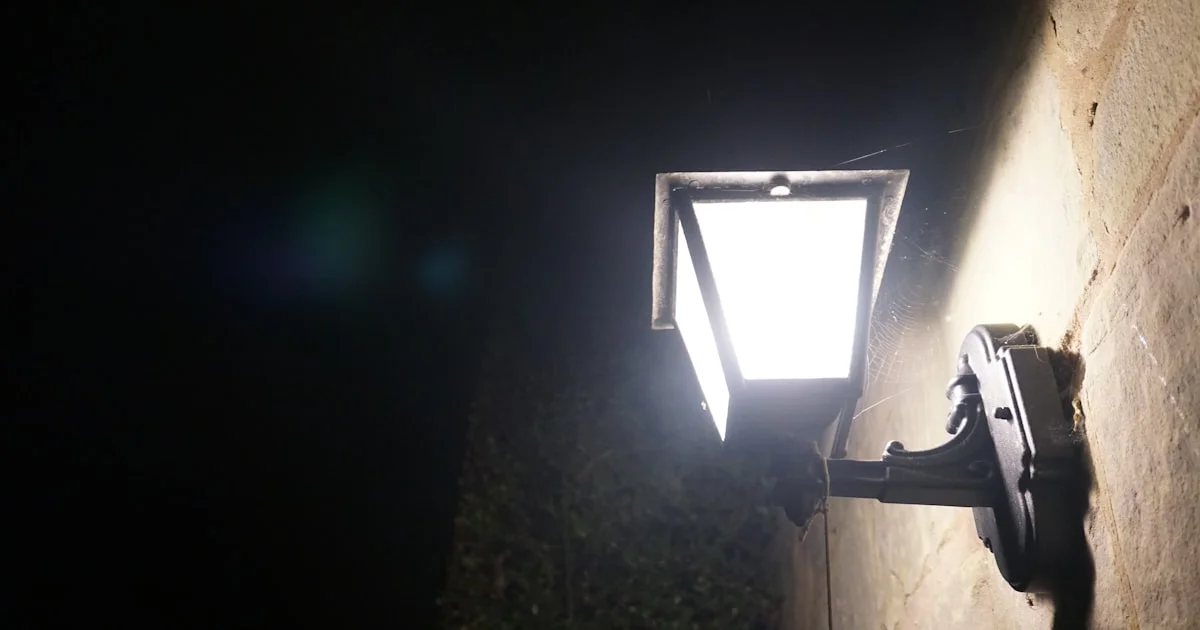
A solar motion sensor light review is only useful if it addresses the thing that actually determines performance: how much direct sun the panel receives. The light, sensor, and battery all matter, but a well-specified fixture mounted where the panel sits in shade will disappoint every time.
Key Takeaways
- Panel sun exposure decides performance more than any specification on the box.
- Lumens describe brightness; detection range and angle describe whether the light triggers when you need it.
- LiFePO4 batteries survive far more charge cycles and cold weather than older lithium-ion cells.
- Winter performance drops sharply — shorter days, lower sun angle, and cold batteries compound.
- Separate-panel designs let you mount the light where you need it and the panel where the sun is.
What a solar motion sensor light review should actually test
The short answer: whether it still triggers reliably at the end of a cloudy winter week, not how bright it is on a summer evening after a full day of charge.
Most disappointment with these lights traces to one of three causes — insufficient panel sunlight, a battery too small for the light’s output, or a sensor positioned so it misses approaching movement. None of these show up in a first-week test.
Panel placement is the whole game
A solar panel needs several hours of direct sunlight daily to fully charge the battery. Ambient daylight is not enough. Shade from a tree, a fence, a gutter, or the building itself will cut charging dramatically, and partial shade across a panel can reduce output far more than the shaded fraction suggests.
Before mounting anything, watch the intended spot across a full day:
- Check sun exposure at three points — morning, midday, and late afternoon.
- Face the panel toward the equator — south in the northern hemisphere — and angle it rather than mounting flat.
- Account for winter sun angle, which is much lower and creates shade that does not exist in summer.
- Consider leaf cover — a bare tree in winter becomes dense shade by June.
- Keep the panel accessible, because dust, pollen, and bird droppings reduce output and need occasional cleaning.
- Prefer a separate-panel model where the light must go somewhere shaded.

A practical solar flood light comparison
A useful solar flood light comparison weighs brightness against runtime, because these pull against each other from a fixed battery.
| Specification | What it tells you | What to watch for |
|---|---|---|
| Lumens | Total light output | Higher output drains the battery faster |
| Battery capacity | Stored energy | Must be matched to output, not maximised alone |
| Panel wattage | Charging speed | Meaningless if the panel sits in shade |
| Detection range | Trigger distance | Rated under ideal conditions; expect less |
| Detection angle | Coverage width | Matters more than range for driveways |
| Duration setting | How long it stays lit | Longer settings drain the battery quickly |
| IP rating | Weather resistance | IP65 or better for genuine exposure |
Many lights offer a dim constant mode with a bright burst on detection. This is generally the most practical setting, giving you gentle background light all night without draining the battery on full output.
An outdoor security light honest review of the limitations
An outdoor security light honest review has to address seasonal reality. In summer, long days and a high sun mean batteries charge fully and lights run all night without difficulty. In winter, days are short, the sun sits low, cloud is more frequent, and cold reduces battery capacity — all at once.
The result is that a light performing perfectly in July may fail by 2am in December. This is not a defect; it is the nature of solar in most latitudes. Buying a model with more battery capacity than you need in summer is the practical hedge.
Motion sensors have their own limitations. Passive infrared sensors detect heat movement, which means they respond less reliably to someone approaching directly toward the sensor than to someone crossing its field. They also trigger on animals, blowing vegetation, and occasionally on warm air from vents.
Batteries are the usual end of life. Most of these lights use a sealed battery that degrades over a few years, and many models do not allow replacement — which turns a repairable fixture into a disposable one. Check this before buying, because a replaceable battery can double the useful life.
Installation height and orientation affect more than aesthetics. A fixture mounted too close to a reflective surface, such as light-colored siding or a glass door, can suffer false triggers from its own light bouncing back at the sensor. Leaving a small gap between the fixture and any reflective wall, and angling the sensor slightly downward rather than straight out, reduces this kind of nuisance triggering considerably.
A quick test costs nothing: cover the panel completely for two full days and see how the light behaves on the third night. If it still triggers reliably, the panel is doing its job in that location. If performance drops noticeably, the mounting spot is receiving less useful sun than it appears to from ground level.
A wipe of the panel every few months keeps output honest. Dust and pollen film builds up gradually enough that most owners never notice the decline until a light that used to run all night starts cutting out by 2am, at which point they assume the battery has failed rather than the panel simply collecting less charge than before.
Choosing the best solar light ranked for your situation
Rather than trusting any best solar light ranked list, match the light to the job you need done. Different tasks want genuinely different fixtures.
- Driveways and wide approaches — prioritise detection angle over raw brightness, and mount high enough to cover the whole area.
- Doorways and porches — moderate brightness with a dim constant mode is more pleasant than a harsh flood.
- Paths and steps — several low-output lights beat one bright one, which creates glare and deep shadow.
- Sheds and back gates — separate-panel models let you put the panel on the sunny side of the roof.
- Deterrence — sudden brightness on detection matters more than constant illumination.
- Cold climates — check the stated operating temperature range and prefer LiFePO4 cells.
Mounting height is worth getting right. Too low and the sensor covers a small area and is easy to tamper with; too high and detection sensitivity drops. Manufacturers publish a recommended range, and it is usually accurate.
Frequently Asked Questions
These questions come up most often about solar security lighting.
Do solar motion lights work in winter?
They work, but with reduced runtime. Shorter days, a lower sun angle, more cloud, and cold-reduced battery capacity all combine. Choosing a model with generous battery capacity and angling the panel to catch the low winter sun both help considerably.
How long do the batteries last?
Typically a few years before capacity drops noticeably. LiFePO4 cells last considerably longer than older lithium-ion. Check whether the battery is replaceable — many are sealed, which means the whole fixture is discarded when it fails.
Why does my light trigger when nothing is there?
Passive infrared sensors respond to moving heat. Animals, blowing branches, warm exhaust from vents, and even rapid temperature changes can trigger them. Reducing sensitivity or repositioning the sensor away from vegetation usually resolves it.
Can I mount the panel separately from the light?
On separate-panel models, yes — they include a cable of a stated length, which is the main advantage of that design. Integrated models fix the panel to the fixture, so the light must go wherever the sun is.
Conclusion
Watch your intended mounting spot across a full day before buying anything, then choose battery capacity for winter rather than summer. Get the panel into genuine direct sun and almost any decent fixture performs well; get that wrong and no specification will save it.


