

The cable you need is never the one on top. That is the entire problem, and it is why a pouch that costs less than a sandwich can save you more irritation per dollar than almost anything else you carry. Picking a top cable organizer bag 2026 is not really a shopping question, though — it is an inventory question with one federal rule attached, and the rule is the part most buying guides leave out.
The power bank decides which bag you buy
Before compartments, before materials, before anything: if a power bank lives in this bag, the bag is a carry-on bag. The FAA is unambiguous that “spare (uninstalled) lithium ion and lithium metal batteries, including power banks and cell phone battery charging cases, must be carried in carry-on baggage only.” The reason it gives is worth quoting too, because it explains the rule rather than just stating it: “flight crews are trained to recognize and respond to lithium-ion battery fires in the cabin.”
Two more numbers from the same guidance shape what you can carry. Rechargeable lithium ion batteries are limited to a rating of 100 watt hours each, with up to two spares in the 101 to 160 watt hour range permitted only with airline approval. And the terminals “must be protected from short circuit” — they must not touch other metal.
That last line is a design requirement, not a warning label. A bag that lets a power bank rattle loose against a pile of USB-C ends and a set of keys is failing at the one job with a rule behind it. Look for a dedicated padded pocket that closes, not a shared main cavity.
How to buy the best cable organizer bag in five steps
Work in this order, because step one changes the answer to everything after it. If you are wondering how to buy the best cable organizer bag without buying three of them first, this is the short version.
- Empty your current bag onto a table. Everything. Count it. There are almost always two cables in there that have not been used since the phone before last.
- Separate the thick items from the flat ones. Power bank, wall charger and any adapter dongle are the bulk. Cables are flat. A bag sized for the flat things will not close on the thick things.
- Give the battery its own closed pocket. See above. Padded, zipped, isolated from metal.
- Decide whether it lives inside a bag or is the bag. A pouch that rides inside a backpack can be soft. A pouch that goes into a checkpoint bin on its own needs structure.
- Buy one size larger than your count suggests. Every one of these fills up. A bag at capacity on day one is a bag you stop closing properly by month three.
Every top cable organizer bag 2026 shortlist starts with an inventory
The reason step one matters so much is that these products are sold on capacity claims that mean nothing without your own numbers. “Holds 20 items” is not a specification. Four cables, two chargers, a power bank, earbuds and a memory card reader is a specification, and it points at a small case. A photographer’s kit with batteries, filters, a card wallet and three cable types points somewhere else entirely.
Once you have the count, the choice collapses into two shapes.
What a flat elastic board gives you
The flat option is a soft panel crossed with elastic webbing, sometimes in a slim zip shell. You slide each item under a band and everything is visible at once. Nothing is hidden, nothing has to be dug for, and the whole thing lies flat against the back panel of a backpack or inside a laptop sleeve.
The trade is depth. Elastic holds flat things beautifully and round things badly. A chunky wall charger sits proud of the panel and turns a slim board into a lumpy one, and a loose power bank under a band is exactly the short-circuit risk the FAA guidance is about. Some boards add a zipped mesh pocket for this; those are the ones to look at.
Who a flat elastic board suits
It suits the daily commuter with a settled, mostly flat kit: one or two cables, earbuds, a slim charger, maybe a card reader. It suits anyone who already carries a backpack with a padded laptop compartment, because the board disappears into it.
It suits people who lose things in pouches. Total visibility is a real feature if you are the sort of person who has bought the same cable twice.

What a structured zip case gives you
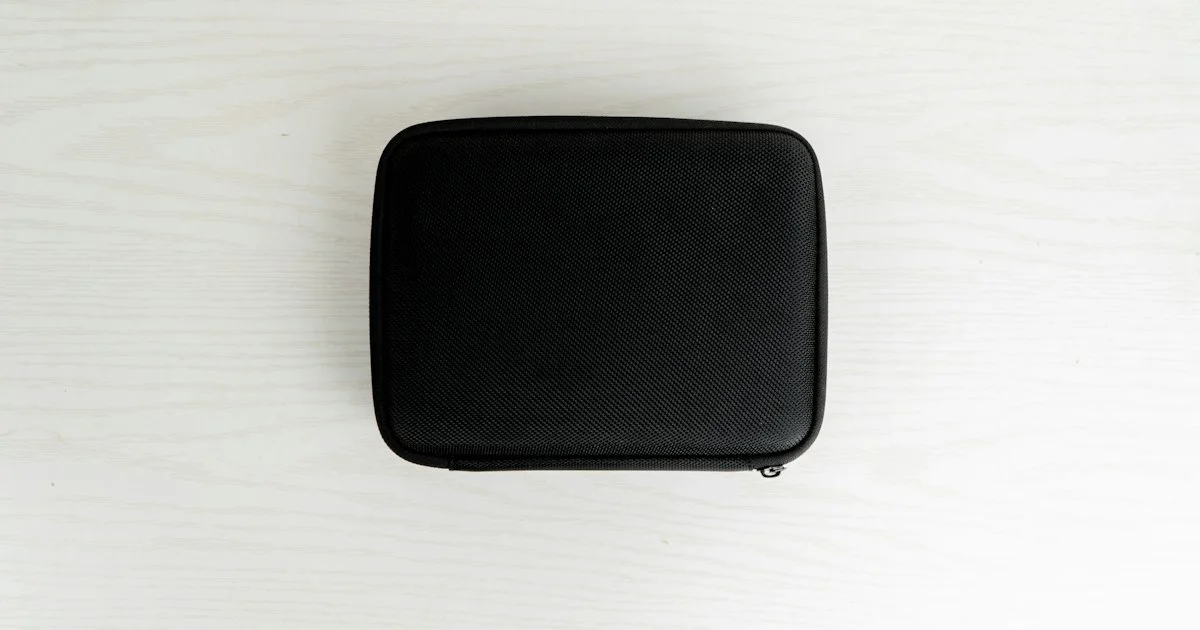
The structured option is a semi-rigid shell — usually molded foam under ballistic nylon — that zips around the edge and opens into two trays. One side is typically elastic loops and mesh, the other a padded well deep enough for a power bank and a wall charger.
You get protection, shape and a case that survives being crushed at the bottom of a bag. You also get a case that holds its volume whether it is full or not, which is exactly the wrong property if you are counting space in a carry-on. And the shell adds weight: a hard case typically runs a few ounces heavier than a soft panel holding the same kit.
Who a structured zip case suits
It suits anyone flying regularly. It lifts out of a backpack in one motion and goes into a screening bin as a single object, which is the difference between a smooth checkpoint and unpacking on a metal table. It suits kit with expensive, fragile or round items in it. And it suits shared household gear, because a closed case with a shape is a case people put things back into.
What the best cable organizer bag for USA fliers has to survive
The best cable organizer bag for USA travel gets handled more than a home-office pouch ever will, so a few construction details earn their keep:
- Zipper quality over everything. The zipper is what fails first on every bag in this category. Chunky teeth, smooth pulls, and a track that curves without binding at the corners.
- A grab handle or wrist loop. Sounds trivial. It is the difference between lifting the case out of a packed bag and excavating it.
- Water resistance, not waterproofing. Coated nylon and a covered zipper will handle a spilled drink on a tray table. Nobody needs a submersible cable pouch.
- A light interior. Black cables inside a black case is a design that fights you. Gray or colored linings make the contents legible in an aircraft cabin.
- Elastic that is sewn, not glued. Check the ends of the bands. Glued elastic peels.
Which cable organizer bag should I buy: a decision table
The question which cable organizer bag should I buy resolves quickly once you know what the bag has to do. Find your line.
| If this is you | Lean toward | Because |
|---|---|---|
| Same commute, two cables, one charger | Flat elastic board | Slimmest option, and everything is visible at once |
| Flying every month with a power bank | Structured zip case | One-motion removal at screening and a closed battery pocket |
| Camera or audio gear alongside cables | Structured zip case, larger size | Padded wells protect round and fragile items |
| A drawer of shared household cables | Structured zip case | A shaped case is one people actually refill |
| Already carrying a padded backpack | Flat elastic board | Adds almost no volume inside a sleeve you already have |
| You keep buying duplicate cables | Flat elastic board | Nothing hides, so nothing gets replaced twice |
Frequently Asked Questions
The questions that come up once the shortlist is down to two.
Can I check a bag with a power bank in it?
No. FAA guidance puts spare lithium batteries, power banks included, in carry-on baggage only. If the pouch holds a battery, the pouch flies in the cabin with you.
Does a hard case really protect cables?
It protects the connector ends, which is where cables actually fail. The middle of a cable is fine in a soft pouch; the strain point at the plug is not, and a shaped case stops it being bent against something hard.
How big should the bag be?
Size it from your own count, then go one step up. The common mistake is buying for the kit you have today and discovering that a new dongle has nowhere to live.
Is a roll-up organizer worth considering?
For long thin items it works well and packs into odd gaps in a suitcase. It is poor for anything with bulk, and it is slow to open on a tray table, so treat it as a suitcase product rather than a daily one.
Conclusion
This is a small purchase with one hard constraint and one soft one. The hard constraint is the battery: it flies in the cabin, in a pocket where its terminals cannot touch metal. The soft one is your own inventory, and it decides everything else. Count first, buy one size up, and check the zipper before the marketing copy.


