

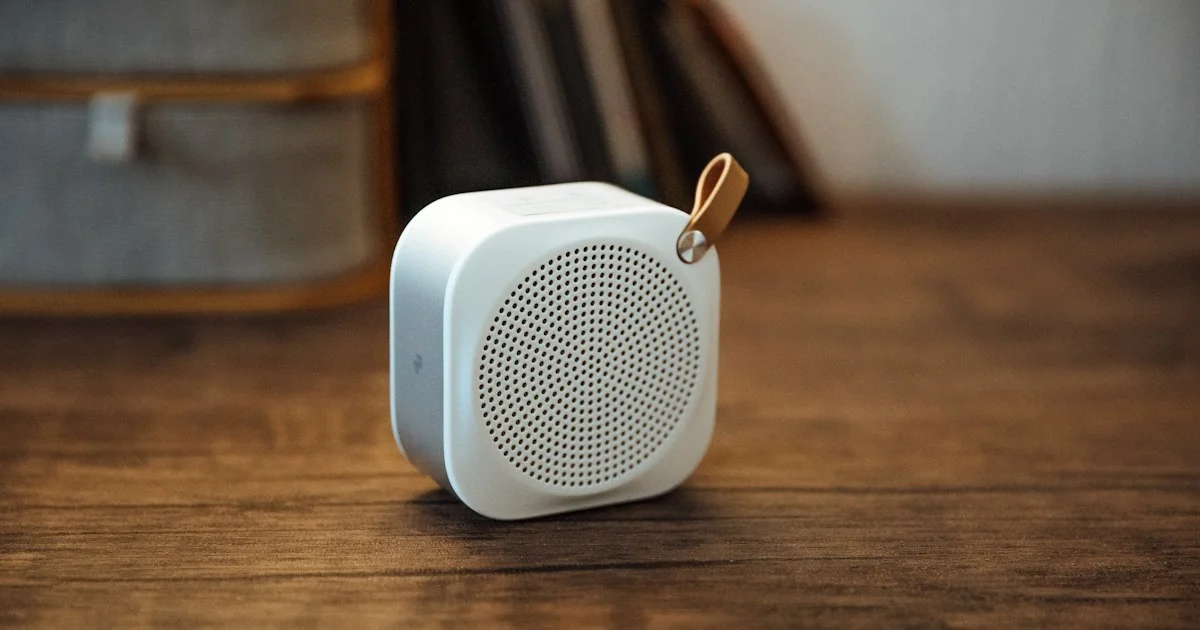
Portable speakers are sold on two numbers — watts and battery hours — and both are close to meaningless on their own. Working out how to buy a bluetooth speaker is mostly a matter of ignoring the box and checking four things the box rarely puts in large type: size, water rating, real battery behavior, and whether it has a microphone.
How to buy a Bluetooth speaker in five steps
Run these in order. Each one eliminates a whole shelf of options, which is faster than comparing spec sheets side by side.
- Decide where it will actually live. A shower, a backpack, a patio, and a kitchen counter each point to a different size and a different water rating.
- Set the water rating from that. IPX4 handles splashes and rain. IPX7 and above survive being dropped in. IP44 adds dust protection alongside water.
- Size the speaker to the bass you expect. Physics does not negotiate here, and the next section explains why.
- Check your phone, not the speaker, for codecs. iPhones are limited to AAC for high-quality Bluetooth audio. Android users get more from a speaker that supports aptX.
- Read the battery claim as a best case. Quoted hours are measured at moderate volume with the extras switched off.
What a pocket-sized speaker gives you
Pocket speakers — the clip-on pucks and cubes that fit in a hand — win on convenience and lose on bass. That is not a manufacturing shortcut. Small, few driver units cannot push air hard, fast, and consistently enough to reproduce sub-bass, so a speaker this size will never produce low end you feel.
What they do offer is genuinely useful: a clip or loop that attaches to a bag or a shower caddy, a high water rating for their price, and battery life that often beats larger models. Testing has shown a small clip-style speaker outlasting a much bigger one from the same range, because the bigger model spent its power on LED lighting.
Who a pocket speaker suits
- Showers, bike handlebars, and anywhere it may get dropped or soaked
- Travelers who care more about packed size than about low end
- Podcast and audiobook listeners, where bass barely matters
- Anyone who wants a second speaker to leave in a bag permanently

What a full-size portable speaker gives you
Once a speaker is roughly the size of a water bottle, real bass becomes possible. Most models this size use passive bass radiators — the flat plates you can often see moving at the ends of the cabinet — which are driven by air pressure inside the housing rather than by their own amplifier. They are an efficient way to extend low end in a small box, though they cannot get as loud as a separate woofer can.
Bigger cabinets also tend to mean longer battery life, more volume before distortion, and more often a built-in microphone for calls. The cost is that you carry it deliberately rather than forgetting it is in your bag.
Who a full-size portable suits
- Backyards, patios, and rooms where one speaker has to fill the space
- Music with real low end, where a pocket speaker sounds hollow
- People who want stereo pairing with a second matching unit later
- Anyone who takes calls on it and needs a microphone
Ratings, codecs, and battery: choosing the top bluetooth speaker for USA buyers
The top bluetooth speaker for USA shoppers is the one whose water rating matches where it will be used, not the one with the highest number. IPX4 is the standard water-resistant rating and is plenty for rain or a splash by a sink. IPX7 and above withstands submersion, which is what a poolside or shower speaker needs. It is worth being clear-eyed about this: no electronic device is fully waterproof, and with enough time and depth any speaker eventually fails.
What to check before calling anything the best bluetooth speaker for USA homes
Calling something the best bluetooth speaker for USA homes means checking three things the marketing skips. Codecs are decided by your phone — every Bluetooth speaker supports SBC as a baseline, iPhones cap out at AAC, and aptX support is only worth paying for on Android. Battery claims assume moderate volume, so anything with lights or a bright display will fall well short. And multi-speaker pairing almost always requires the manufacturer’s own app, so two speakers from different brands will not link.
Which bluetooth speaker should I buy?
If you are still asking which bluetooth speaker should I buy, work from the left column. These are types rather than models, so they stay accurate as products get replaced.
| If you want this | Choose this |
|---|---|
| Something for the shower or the pool | Pocket size, IPX7 or higher |
| Bass you can actually feel | Bottle-size cabinet with passive radiators |
| The longest real-world battery life | Larger cabinet, no LED lighting |
| Speakerphone use | A model that explicitly lists a built-in microphone |
| Stereo sound later on | Two matching units from one brand’s app ecosystem |
| Beach and campsite use | IP-rated for dust as well as water |
Frequently Asked Questions
These come up most often once the choice is down to two speakers at similar prices.
Do Bluetooth codecs really matter for a speaker?
Less than for headphones, and your phone decides it anyway. Every speaker supports SBC. iPhone users are limited to AAC regardless of what the speaker offers, so aptX support is only a reason to pay more if you are on Android.
What is the difference between IPX4 and IPX7?
IPX4 protects against splashes from any direction — rain, a wet countertop, poolside spray. IPX7 covers actual submersion. If there is any chance the speaker ends up in water rather than near it, IPX7 is the one to look for.
Why does my speaker’s battery die faster than advertised?
Quoted figures are measured at moderate volume with extras disabled. Loud playback draws far more power, and light shows drain batteries hard — in testing, a small clip speaker has outlasted a much larger model from the same range purely because the larger one was lighting up.
Can I pair two different speakers together?
Usually not. Stereo and multi-speaker pairing runs through the manufacturer’s app and only works across that company’s compatible models. If you think you will want a pair later, buy both from the same range.
Conclusion
Pick the size that matches the room and the water rating that matches the place, and the rest of the decision is small. A pocket speaker is the right answer far more often than the marketing suggests, and a bottle-size cabinet with passive radiators is what to buy when you genuinely want low end.


